
NAIL Conference 2026: AI, Finance & Law
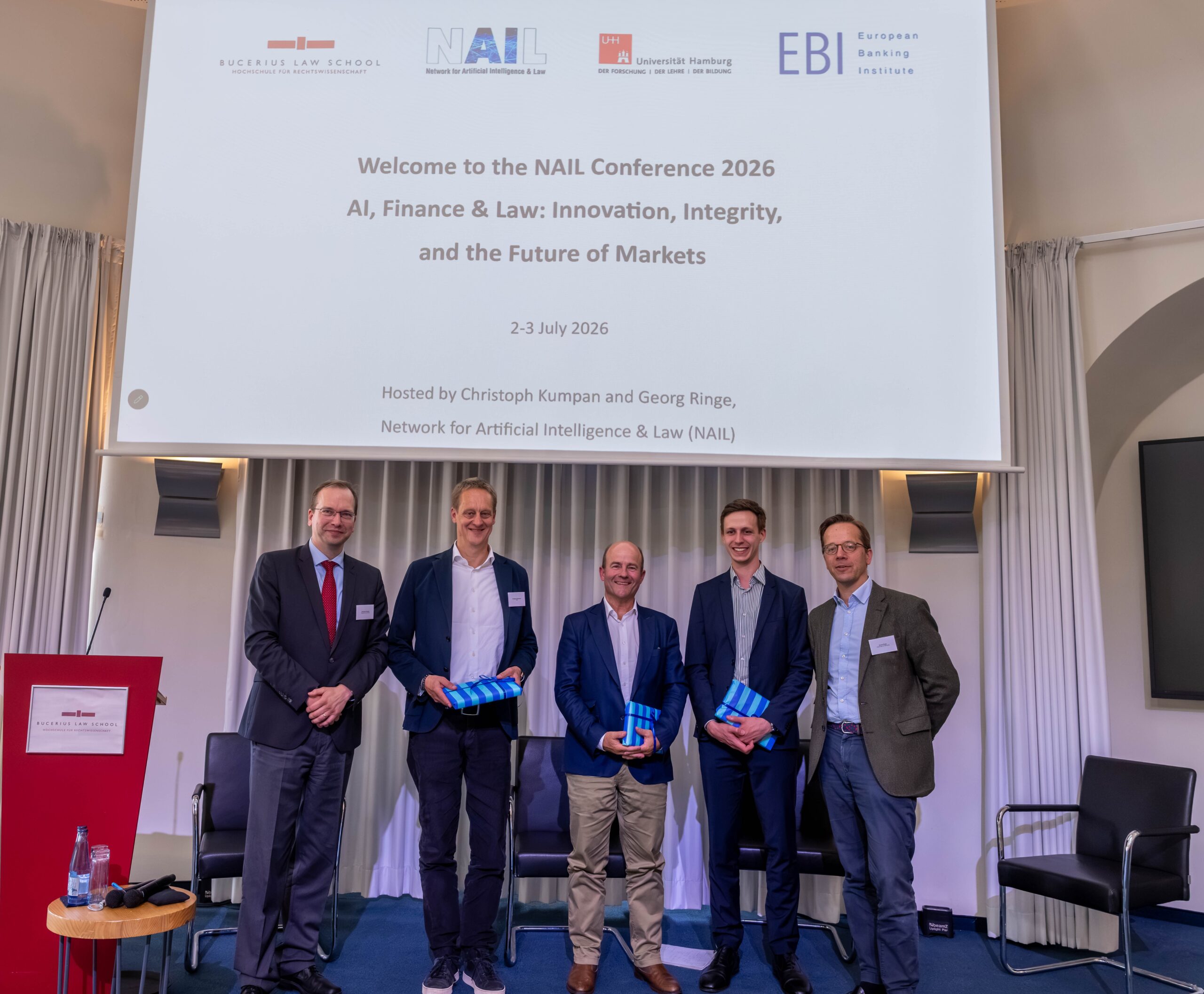
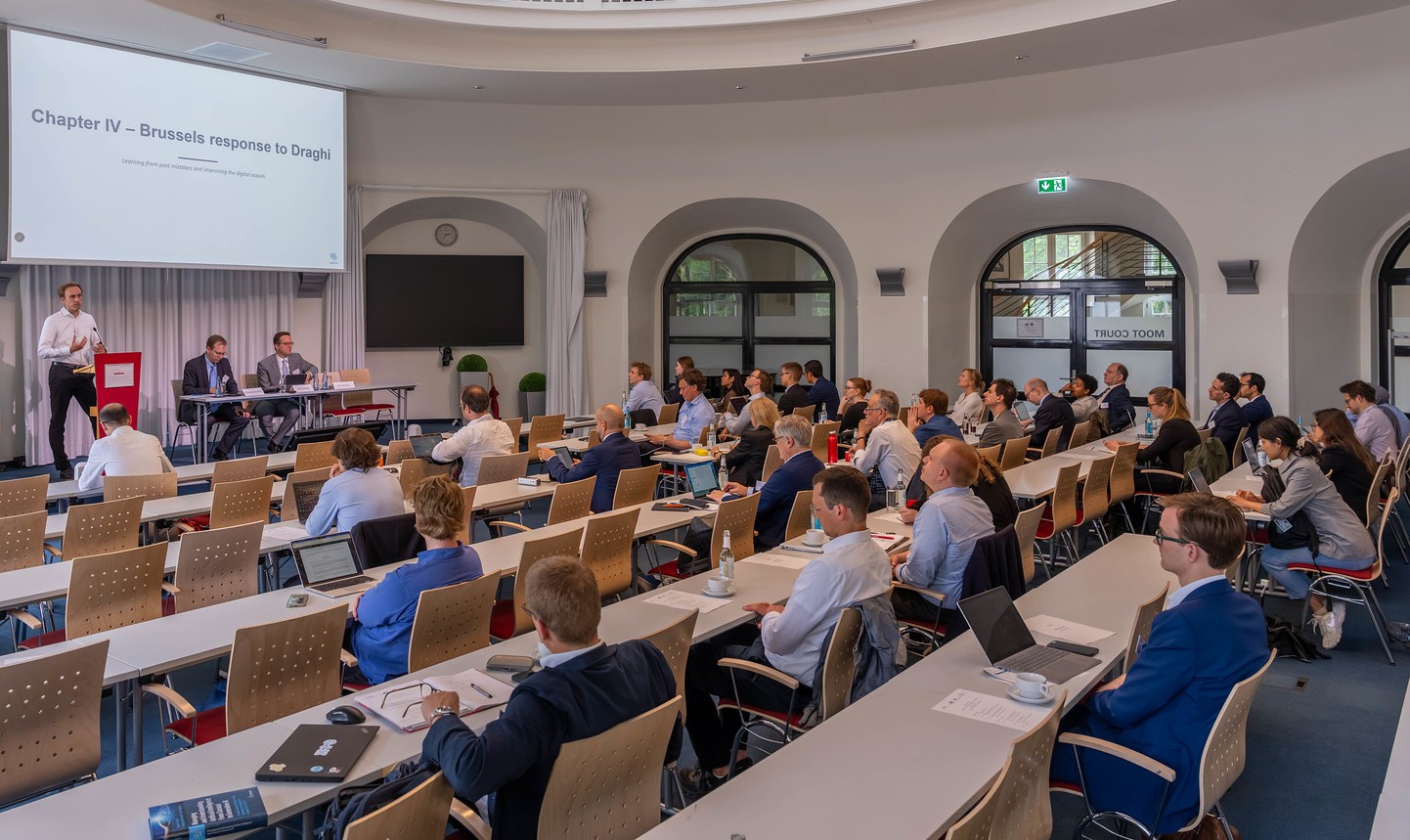
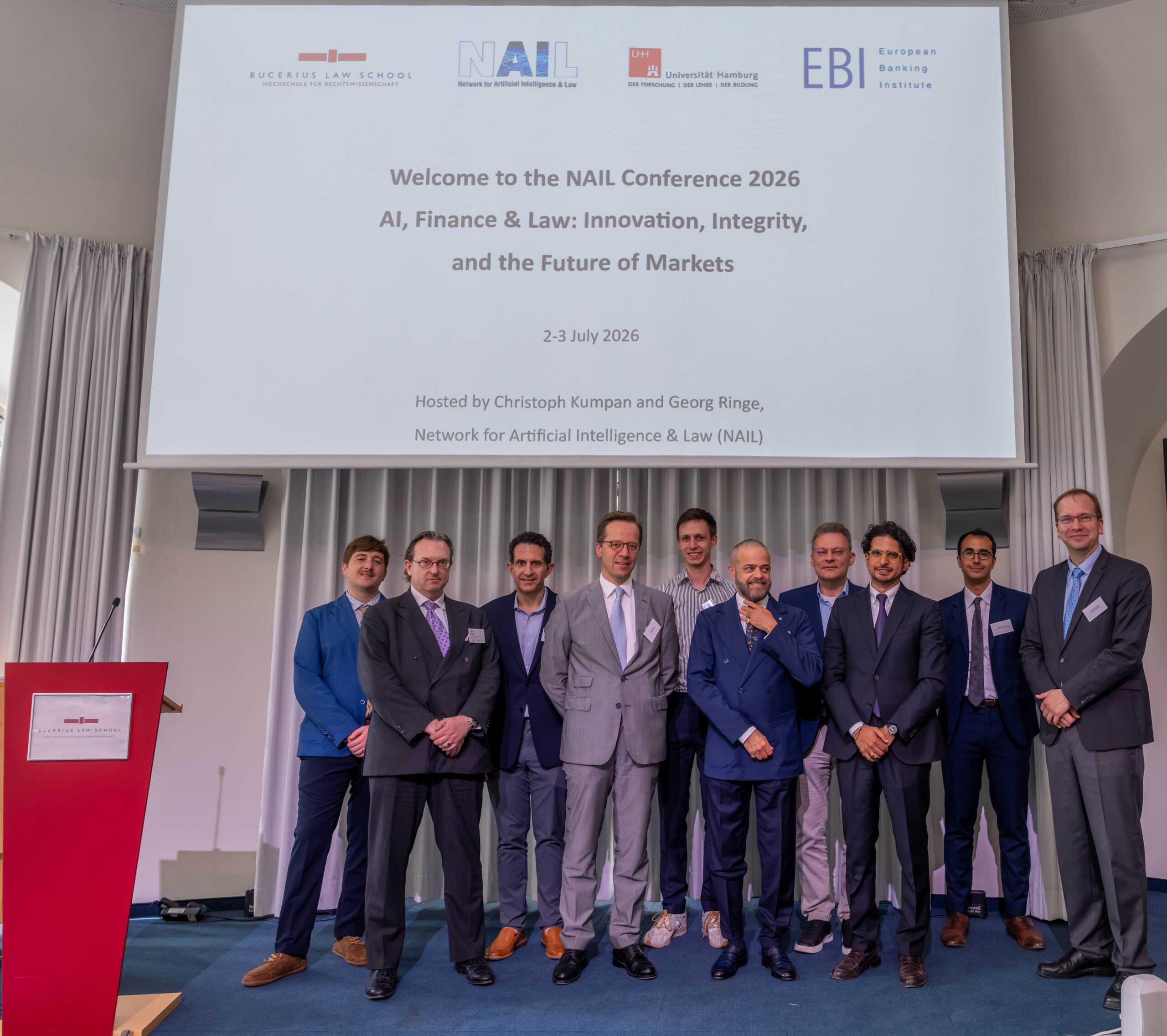
On 2 and 3 July 2026, Christoph Kumpan (Bucerius Law School) and Georg Ringe (University of Hamburg) hosted the Hamburg Network for AI & Law (NAIL) Conference at Bucerius Law School on the theme of ‘AI, Finance & Law: Innovation, Integrity, and the Future of Markets’. The conference was held in cooperation with the European Banking Institute. Bringing together scholars, regulators, policymakers, and practitioners, the conference examined how artificial intelligence is changing financial markets and testing established approaches to regulation at a time when financial markets are increasingly shaped by AI and policymakers are searching for appropriate regulatory responses. The programme featured speakers from leading universities, regulatory authorities, and industry across Europe, North America, and Asia.
Kai Zenner (European Parliament) opened the conference with a keynote on the implementation of the EU AI Act and the current turn towards regulatory simplification. He argued that the central difficulties lie less in regulatory complexity itself than in the architecture of the AI Act: a framework derived from product-safety regulation is being applied to systems that continue to evolve after deployment, while supervision remains fragmented across institutions and jurisdictions.
Several contributions examined how AI challenges legal concepts developed around human decision-making. Gabriel Rauterberg (Columbia Law School) showed how algorithms may develop manipulative trading strategies without the human intent on which market-manipulation rules traditionally rely; Alessio Azzutti (University of Glasgow) drew out the implications for regulatory design. Yesha Yadav (Vanderbilt University) examined how agentic AI can separate general human authorisation from the execution of individual payments, with Marco Dell’Erba (University of Zurich) focusing on the regulatory significance of that distinction. Stavros Gadinis (UC Berkeley) turned to corporate governance and the allocation of authority and responsibility for AI within firms, while Matthias Armgardt (University of Hamburg) questioned whether these mechanisms remain effective as AI becomes more autonomous and whether they operate with comparable force across different regulatory and enforcement environments.
Attention then shifted from private market actors to the use of AI within legal and regulatory institutions. Felix Steffek (University of Cambridge) presented research on AI-based court outcome prediction, including the methodological challenge of data leakage. Daniel Katz (Chicago-Kent College of Law) placed the findings in the wider debate on judicial prediction. Douglas Arner (University of Hong Kong) argued that AI regulation must distinguish between fundamentally different forms of financial risk, while Chris Biemann (University of Hamburg) questioned whether conventional ideas of explainability and human oversight remain adequate for generative AI.
The final session turned from the regulation of AI to the use of AI by regulators themselves. Filippo Annunziata (Bocconi University) explored the possibilities and limits of Supervisory Technology (‘SupTech’) in increasingly datafied markets: better data may improve automated supervision, but open-ended concepts such as misleading signals or artificial prices cannot simply be translated into computational parameters. Dörte Poelzig (University of Hamburg) emphasised that SupTech must remain anchored in the normative foundations of EU financial market law.
Maximilian Mähr (BaFin) highlighted the tension between technology-neutral supervision and the broad scope of the AI Act, as well as the challenges posed by increasingly data-driven models. A concluding practitioner panel with Axel von dem Bussche (Taylor Wessing), Wolfgang Hildesheim (IBM), and Mähr brought these questions back to current practice, examining specialised AI systems, changes in professional work, and the distance that sometimes remains between technological debate and operational reality.
Across the two days, the conference demonstrated that AI is not simply another technological innovation for financial markets. Rather, it challenges some of the foundational legal assumptions – regarding intent, authorisation, explanation, and human responsibility – on which existing regulatory frameworks continue to rely.
(Click to see more)